
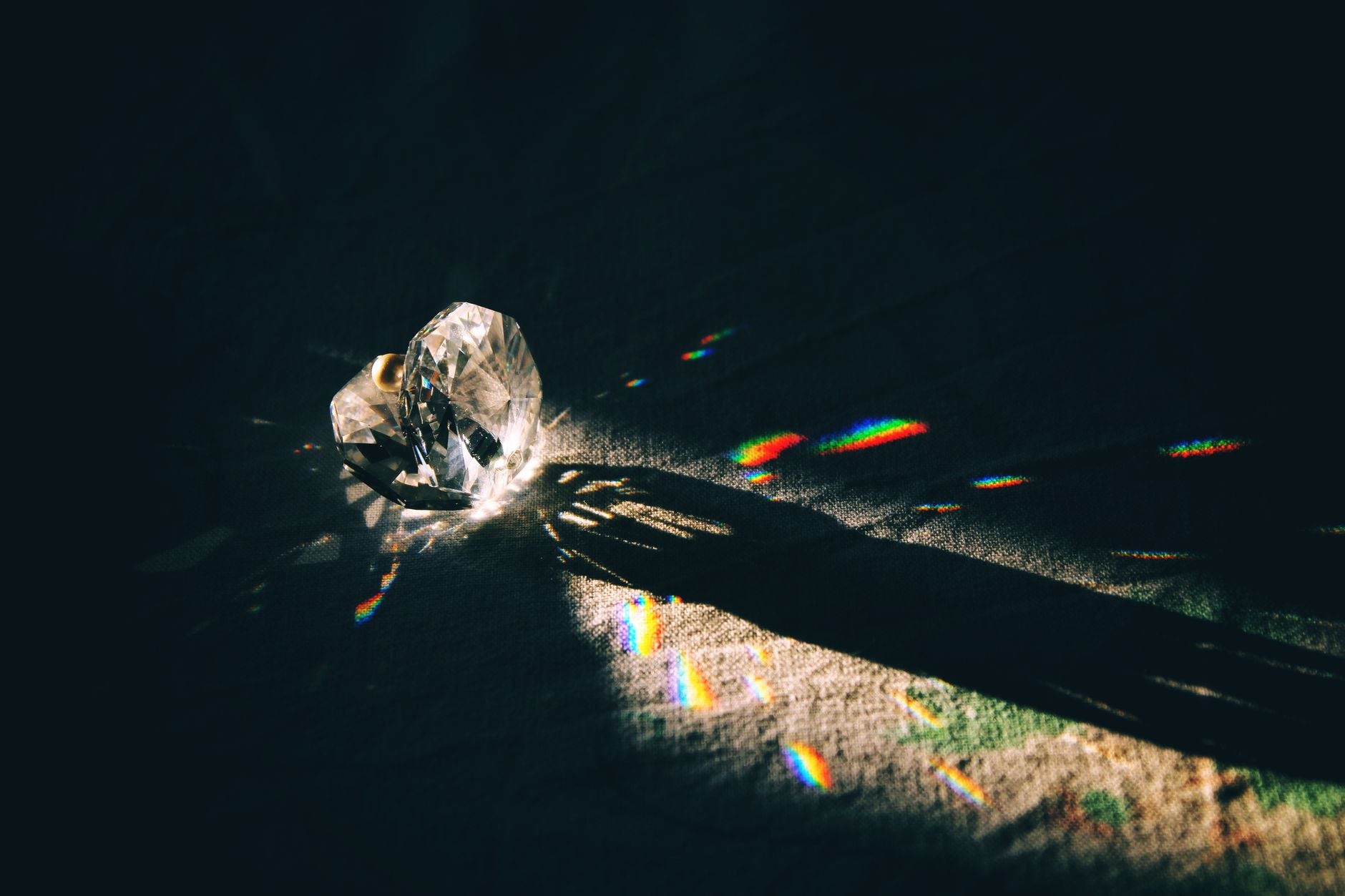
A reaction to UV energy
What is diamond fluorescence?
Diamond fluorescence is the visible glow some diamonds emit while exposed to ultraviolet radiation, which is present in sources such as sunlight and black lights. The glow generally stops when the UV source is removed.
Fluorescence is not the same as the flashes of rainbow colour you see when a diamond moves in ordinary light. Those flashes are fire, one aspect of light performance. Fluorescence is also separate from phosphorescence, an afterglow that continues after excitation stops.
It does not prove that a diamond is natural, laboratory-grown or an imitation. Origin requires suitable gemological testing and report evidence.
An identifying characteristic
Diamond fluorescence scale
| Description | What it records | Buying approach |
|---|---|---|
| None | No fluorescence observed under the test conditions. | Still assess the complete stone and report. |
| Faint | A weak reaction under long-wave UV. | Usually not apparent in ordinary viewing. |
| Medium | A clearer UV reaction. | Compare appearance across ordinary and UV-rich lighting. |
| Strong | A pronounced reaction under UV. | Inspect transparency and face-up appearance individually. |
| Very Strong | The strongest reported intensity category. | Review the actual stone carefully rather than assuming good or bad. |
When GIA records Medium, Strong or Very Strong fluorescence, the fluorescence colour is also noted. Blue is by far the most common colour, though other colours occur.
Usually less dramatic than expected
Does fluorescence affect how a diamond looks?
GIA research found that the strength of blue fluorescence had no widely noticeable face-up effect for the overwhelming majority of diamonds studied, and average observers could not consistently distinguish fluorescent from non-fluorescent stones.
The effect depends on the UV content of the lighting. A diamond may react in bright sunlight or under a black light but show no obvious fluorescence under many indoor lights. That is why a report description should not be treated as a permanent visible colour.
Review the diamond in diffuse daylight and ordinary indoor light where possible. A dedicated UV lamp demonstrates the reaction, but it does not reproduce every everyday environment.
Separate grade from perception
How does fluorescence relate to diamond colour?
Fluorescence does not change the laboratory D-to-Z colour grade. GIA colour grading uses controlled conditions designed to prevent fluorescence from influencing the assigned grade.
Under UV-rich lighting, blue fluorescence can sometimes make a diamond with yellow body colour appear less yellow because blue and yellow are complementary. The effect varies and should not be promised from the fluorescence description alone.
Two common myths
Does strong fluorescence make diamonds hazy or weak?
Haze is rare
GIA reports that in rare cases diamonds with extremely strong fluorescence may appear hazy or oily; fewer than 0.2% of fluorescent diamonds submitted in the cited research showed this effect. Inspect the actual stone.
Fluorescence does not weaken diamond
The atomic features that cause fluorescence do not inherently reduce structural integrity. Durability questions should instead consider inclusions, girdle, shape and setting.
Haze can have other causes. Do not diagnose transparency from fluorescence intensity alone, and do not assume every Very Strong stone will look oily.
No universal premium or penalty
Does fluorescence affect diamond price?
Trade preferences can influence price, but there is no simple rule that fluorescence always adds or subtracts value. The relationship can vary with colour grade, intensity, observed colour, transparency, market preference and the individual stone.
Compare otherwise similar diamonds and decide whether you like the appearance. A discount is not useful if the stone looks hazy to you; a premium is not justified merely because blue fluorescence is described as beneficial.
A five-step check
How to evaluate fluorescence when buying
- Read the report.Note intensity and, where listed, fluorescence colour.
- Inspect normal-light imagery.First decide whether you like the diamond's everyday face-up appearance.
- Check transparency.Look for milkiness or haze without assuming fluorescence is the cause.
- Compare lighting.Use diffuse daylight and indoor light; use UV only to demonstrate the reaction.
- Compare the whole diamond.Balance cut, colour, clarity, dimensions, report and price rather than filtering by fluorescence alone.
Common questions
Diamond fluorescence FAQs
Is diamond fluorescence good or bad?
Neither by definition. For most diamonds it has no widely noticeable effect in ordinary viewing. Assess the individual appearance and price.
Do all diamonds fluoresce?
No. GIA research found some degree of fluorescence in approximately 25% to 35% of diamonds submitted over the cited period.
What colour is diamond fluorescence?
Blue is by far the most common, but yellow, orange, white, green and other reactions can occur.
Does fluorescence make a diamond cloudy?
Usually not. Rare diamonds with extremely strong fluorescence may appear hazy or oily, so review transparency on the individual stone.
Does fluorescence mean a diamond is real?
No. Fluorescence is not proof of natural or laboratory-grown origin. Use a reputable grading report and professional identification.
Does fluorescence affect the colour grade?
No. It is reported separately, though blue fluorescence can influence perceived appearance under lighting containing enough UV.
Complete the picture
Related guides
Technical references: GIA: understanding fluorescence, GIA fluorescence myths and research, and GIA fluorescence research summary.